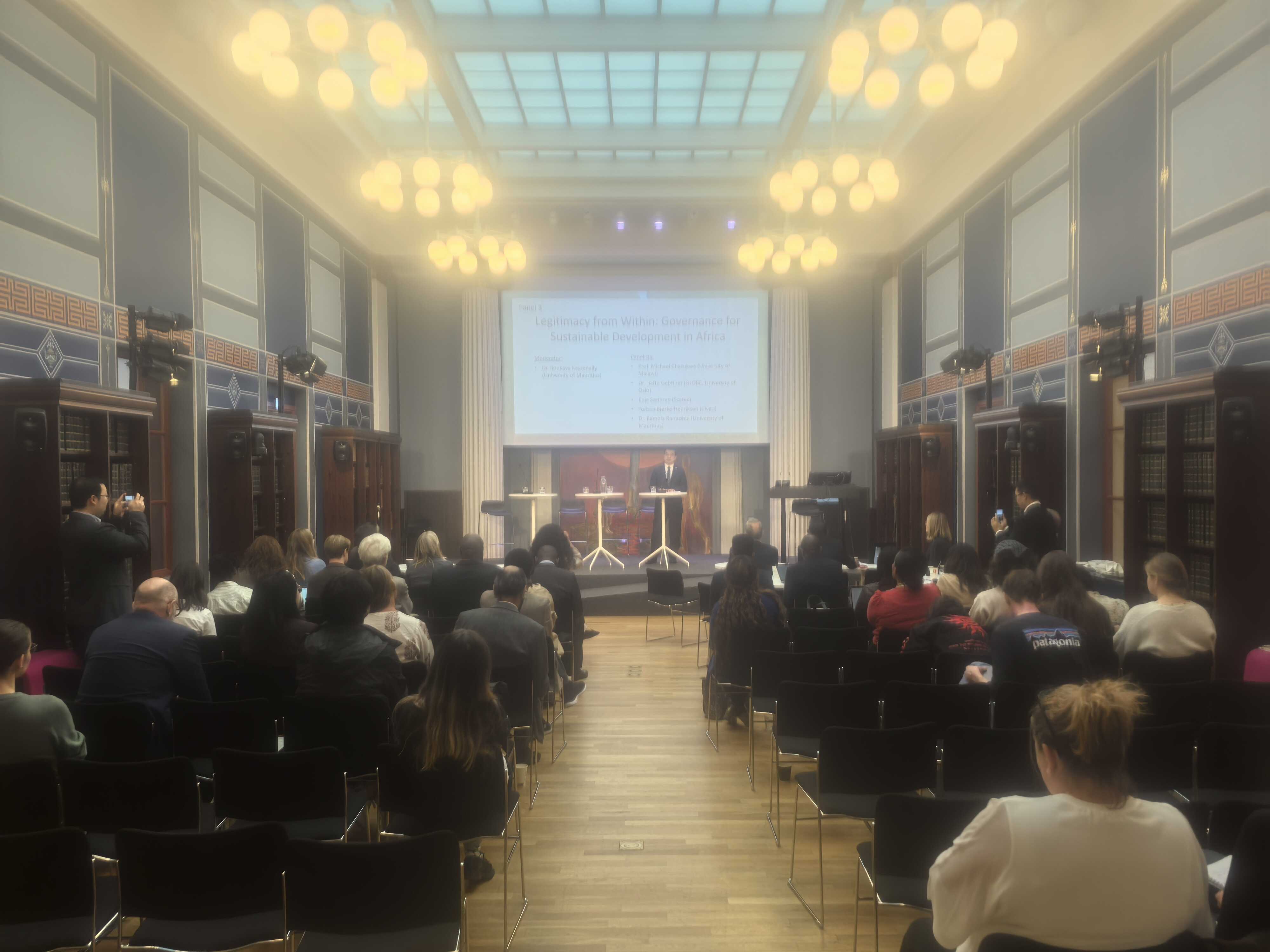
Ambassador Zhou Jingxing Delivers a Keynote Speech at the Seminar Hosted by the Centre for Global Sustainability at the University of Oslo
On 6 October, H. E. Zhou Jingxing, the Chinese Ambassador to Norway, attended a seminar titled “Sustainable Development under the New International Order,” hosted by the Centre for Global Sustainability at the University of Oslo and delivered a keynote speech. More than 70 representatives of Norwegian and African experts, scholars and students were present.
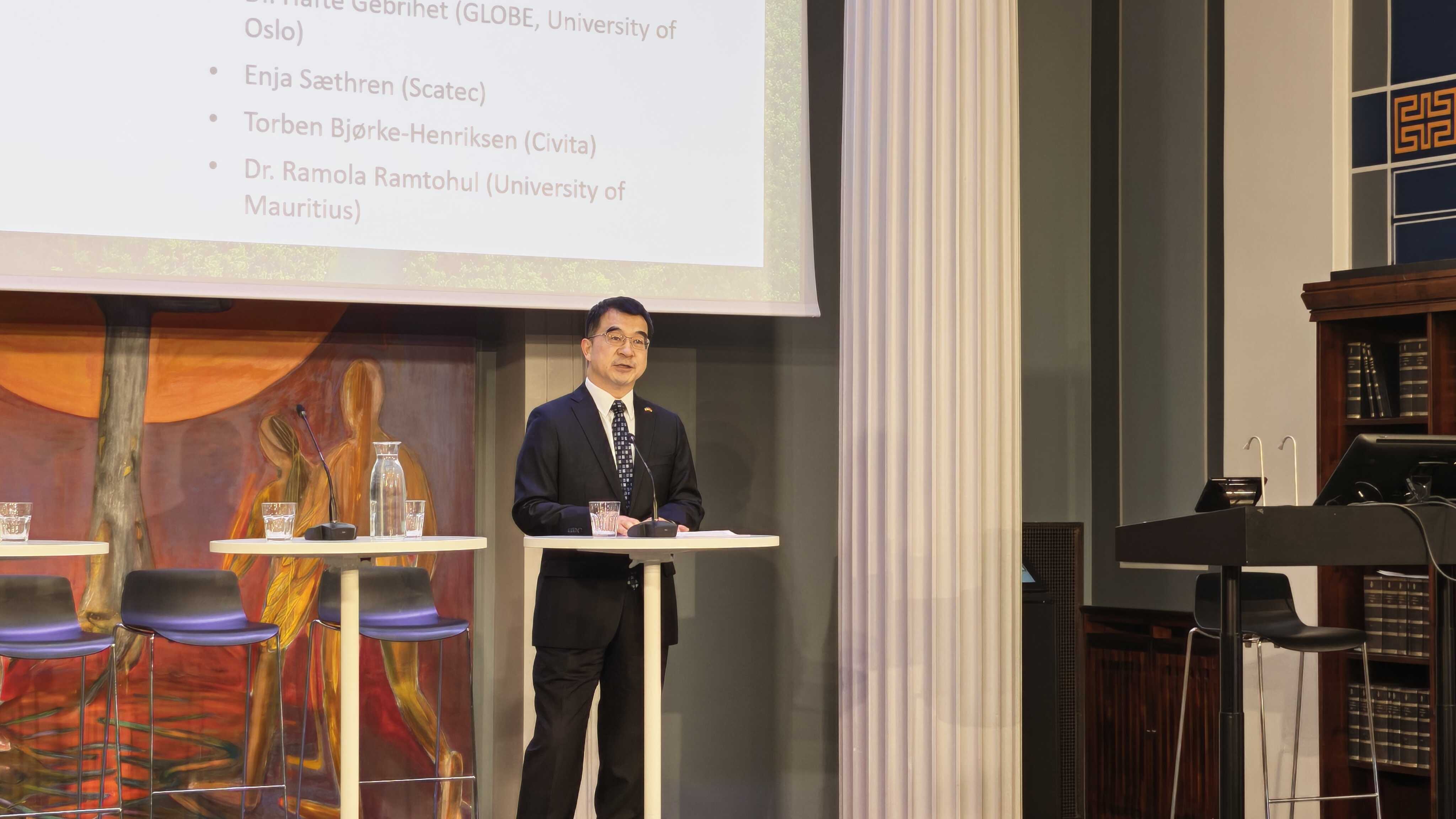
The full text of the speech is as follows:
Professor Dan Banik,
Distinguished Guests,
Ladies and gentlemen,
First of all, I would like to thank the organizers and, in particular, Professor Dan Banik, for the kind invitation. Today, I would like to share with you my thoughts on three aspects: How does China view the Sustainable Development Goals, multilateralism, and its relationship with Africa?
First, on the Sustainable Development Goals.
China has been taking productive, concrete actions to implement the 2030 Agenda for Sustainable Development.
According to the Sustainable Development Report 2026, China’s global SDG Index ranking rose from 63rd in 2015 to the current 49th, climbing 14 places over the decade. To date, China has achieved dynamic monitoring for 92.8% of the 233 SDG indicators, with 60.5% of them already meeting or moving closer toward the targets.
In poverty alleviation, China fulfilled its goals a full decade ahead of schedule. Meanwhile, its urbanization rate increased from 58.8% in 2016 to 67.9% in 2025, expanding urban population from 819 million to 954 million.
These figures are not abstract statistics. Behind them is the tangible transformation and shared prosperity in the daily lives of hundreds of millions of ordinary people.
At the same time, China does not shy away from challenges. It always steps forward to tackle the issues of inadequate and unbalanced development. The 15th Five-Year Plan for Social and Economic Development stresses the importance of high-quality development, which effectively dovetails with the final five years of the 2030 Agenda. We are well aware that achieving SDGs is not a sprint, but a marathon that requires sustained commitment.
Second, on multilateralism.
China's position on multilateralism is deeply rooted in our experience. Our development was achieved within the UN-centered international architecture. For us, multilateralism is not an optional choice—it is an absolute imperative.
In response to the acute global governance deficit, President Xi Jinping proposed the landmark Global Governance Initiative (GGI) at the “Shanghai Cooperation Organization Plus” meeting in September 2025. This initiative is built on five core values: sovereign equality, the international rule of law, multilateralism, a people-centered approach, and real actions.
Over just one year, nearly 160 countries and international organizations have voiced support of the Initiative, and more than 60 countries have joined the Group of Friends of Global Governance. We welcome all like-minded countries to join the Group.
During China’s National Day holidays, I noticed a one-sentence comment under a video clip that my Embassy posted on TikTok. It claims that “China has no friends”. I think the commentator meant “allies” instead of “friends”, and he/she does not understand what true multilateralism means. Multilateralism is not us vs. them; it is about openness and togetherness, among many others. China does not forge alliances, and we seek to build a community with a shared future for humanity. We do not believe in block politics, and we make decisions on international and regional affairs based on the merits and demerits of the matter concerned, rather than looking at how close we are to the interlocutors. We practice true multilateralism, and we have friends around the world.
Third, on China-Africa relations.
Africa has the largest number of developing countries as a continent, and it is crucial for achieving the goals of global development. As the largest developing country and a member of the Global South, China always takes African countries as its good partners and good brothers.
Following the principles of sincerity, real results, amity, and good faith, alongside a firm commitment to doing the right thing, China steadily provides assistance to and promotes practical cooperation with Africa. Over the past 26 years since the inception of the Forum on China-Africa Cooperation, bilateral trade surged from RMB87.38 billion yuan in 2000 to RMB2.49 trillion yuan in 2025, or an increase of 27.5 times.
To sustain this good momentum, China took a historic zero-tariff policy effective 1 May 2026 on all imports from the 53 African nations having diplomatic relations with China. This is one of the most comprehensive, unilateral market-opening measures ever taken toward an entire continent, setting a new benchmark for South-South cooperation.
In education and research, China-Africa cooperation is undergoing a profound paradigm shift—moving from traditional donor-recipient aid toward sustainable, internal capacity building.
The China-Africa STEM Education Teacher Training Cooperation Program was launched in 2025, and is scheduled to hold workshops for three consecutive years. Meanwhile, Luban Workshops and Confucius Institutes have become important platforms for young Africans to receive vocational and technical training. Furthermore, the two sides are steadily pushing forward the China-Africa Universities 100 Cooperation Plan, and introduced several new flagship research projects in 2026.
This year marks the fifth anniversary of the Global Development Initiative proposed by President Xi Jinping. Over the past five years, China has funded 1,800 cooperation projects with over US$ 23 billion, which have taken root and borne fruit in over 120 countries.
But on the other hand, the global SDG financing gap still stands at as much as US$4 trillion every year, and official development assistance dropped drastically by 23% in 2025.
Against this backdrop, China’s robust support through the Global Development Initiative is not merely a contribution in funding; it serves as a vital anchor of stability and a crucial global public good for the international community. This also shows that we must build mutual trust, and take more decisive, concrete actions.
I am very pleased to learn that Professor Dan Banik and Professor Lin Yifu are jointly advancing a collaborative project dedicated to the SDGs. Achieving these goals demands concerted efforts from the government, the business community, and academia.
China stands ready to join hands with Norway, Africa, and all stakeholders committed to sustainable development, and work together to translate commitments into achievements, turn visions into realities, and forge a brighter future for all.
Thank you.